
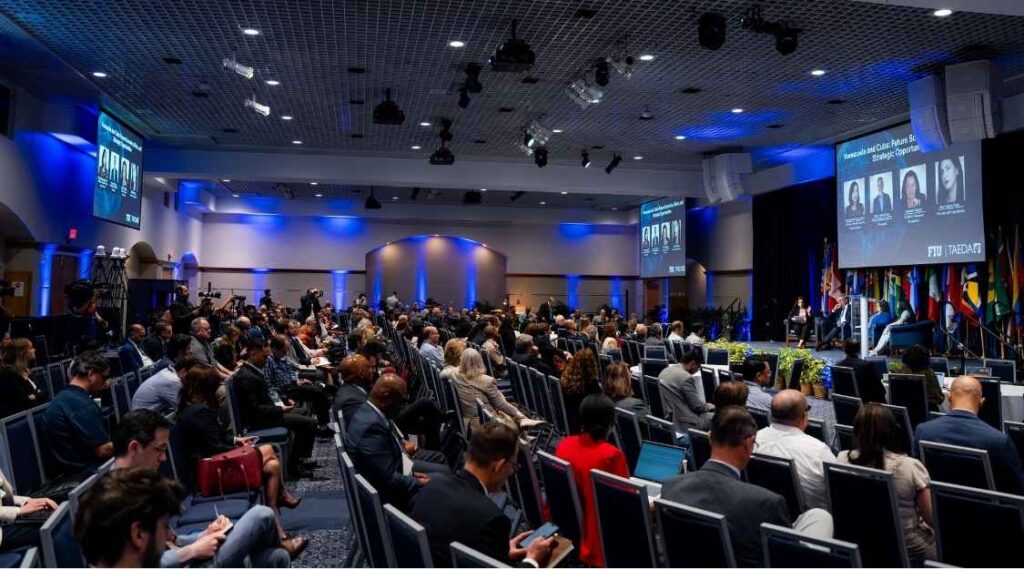
An event is not measured by the quality of the catering or the size of the room. It is measured by the relationships that stay active once the lights go out. Strategic institutional events are, above all, an instrument of soft power: a space deliberately designed so that the right people meet, talk and decide to move forward together. In the United States–Latin America corridor, that convergence does not happen by chance. It is orchestrated.
At Manah Group we do not organize events. We build platforms for bilateral institutional relationship-building where your organization stops being just another attendee and becomes an actor with a recognized voice. That is the difference between renting a room and earning positioning.
What a strategic institutional event is (and what it is not)
The confusion is common and costly. A conventional corporate event seeks visibility; a strategic event seeks influence. The first ends when the agenda concludes; the second only begins there, in the conversations that continue for months.
Strategic institutional events stand out for three traits:
- Qualified attendance: what matters is not how many attend, but who. Officials, the diplomatic corps, academia, business leaders and tier-1 press in the same room.
- An agenda with political and commercial intent: every panel, table and break responds to a relationship objective defined in advance.
- Institutional continuity: the event is part of a long-term relationship with universities, chambers and organizations, not an isolated effort.
When these three elements align, a forum stops being a marketing expense and becomes an asset of corporate diplomacy.
What you achieve with a strategic event
- Qualified attendance: officials, diplomatic corps, academia and tier-1 press in the same room.
- An agenda designed with political and commercial intent, not just protocol.
- Production to an institutional standard validated at high-level forums.
- Media coverage before, during and after the forum.
- Post-event activation: contacts turned into relationships and business.
By-project agenda · Limited production slots
Let’s design your event →Confidential conversation · no commitment · we assess your profile
Miami: the hemisphere’s natural meeting point
No city concentrates the flow of capital, talent and decision-making between North America and Latin America like Miami. With air access to more than 150 international destinations and a genuinely bilingual ecosystem, the city has established itself as the preferred venue for United States–Latin America business summits. Its investment in MICE infrastructure and the density of institutional venues —universities, consulates, binational chambers— make it unbeatable for those seeking legitimacy, not just a stage.
Hosting high-level corporate events in Miami delivers a value no other location offers as naturally: the perception of hemispheric neutrality and prestige. An announcement made from Miami is heard differently from one made from a single national capital.
Our credential: FIU’s Hemispheric Security Conference
The best evidence of a capability is having exercised it at the highest level. Manah Group took part in the strategic production of the Annual Hemispheric Security Conference, the flagship hemispheric security event led by the Jack D. Gordon Institute for Public Policy at Florida International University (FIU), in coordination with actors of the caliber of APCO Worldwide.
Each year that forum brings together government officials, military leaders, academic experts, think tanks and the private sector to address transnational crime, strategic competition and the hemisphere’s economic security. You can review the event’s track record directly at the institutional source, the FIU Gordon Institute.
Working in that environment demands something that cannot be improvised: command of diplomatic protocol, geopolitical sensitivity and flawless execution under institutional scrutiny. It is the same rigor we apply to projects with the Fulbright network and with binational chambers of commerce.
What this means for your organization
It means that when Manah Group coordinates your summit or forum, you operate with the same methodology validated in Miami’s highest-level institutional settings. It is not agency theory: it is demonstrated capability.
From logistics to influence: our method
Our approach to strategic institutional events is structured in four phases that prioritize the relational outcome over visible production.
- Objective diagnosis: who do you need to meet, what perception do you want to establish and what decision do you want to catalyze? Everything starts here.
- Attendance architecture: we activate our institutional network —academia, diplomatic corps, chambers, press— to ensure the room carries the right weight.
- Purposeful agenda design: every session and every informal space is conceived as an opportunity for targeted relationship-building.
- Post-event activation: the real work begins after the event, turning contacts into relationships and relationships into business.
This method explains why our public credentials —MBE-WBE certification, partnerships with FIU and APCO, ties with Fulbright and the diplomatic corps— are not ornaments: they are the trust infrastructure that makes it possible to convene those who truly decide.
Use cases
Strategic institutional events prove decisive when an organization needs to:
- Enter a new market in the bilateral corridor with immediate institutional backing.
- Position a spokesperson or the brand as a legitimate interlocutor before government and academia.
- Announce an investment, alliance or expansion with maximum resonance and credibility.
- Strengthen relationships with regulators, strategic partners and tier-1 press.
In every case, the event is the means; the lasting relationship is the end.
An ecosystem of services that multiplies impact
A strategic event yields more when it is part of a complete positioning strategy. That is why we connect this capability with our communications and media strategy, which secures tier-1 coverage before, during and after the forum, and with our membership program for business leaders seeking permanent belonging to a high-level network. The sum of attendance, coverage and community is what turns a one-off event into sustained authority.
See the service in detail at Strategic Events.
Turn your next event into a strategic decision
If your organization is planning a forum, summit or conference in the United States–Latin America corridor, the right question is not “who can put it together,” but “who can turn it into real influence.” That is exactly our specialty.
Book a confidential conversation with our team through Contact and let’s design an event remembered not only for what was seen, but for what moved afterward.
A business group seeking to enter the bilateral corridor with institutional backing launched its presence with a forum alongside academic and diplomatic actors, and came away with active relationships with regulators and press.
Frequently asked questions
What sets a strategic event apart from a corporate one?
The corporate one seeks visibility; the strategic one seeks influence and relationships that stay active months after the event.
Do you only handle the logistics?
No. We design the complete relationship platform: attendance, a purposeful agenda and post-event activation. Logistics are only one part.
Which institutions do you work with?
We operate with institutional ties —FIU, APCO, Fulbright, the diplomatic corps and binational chambers— that lend weight and credibility to the convening.
What type of organization is it for?
For those who need to enter a market, position a spokesperson, announce an investment or strengthen relationships with government and press.
Will your next forum be an expense or a strategic move?
A well-designed event is remembered not for what was seen, but for what moved afterward. Let’s design yours.
Confidential conversation · no commitment